

Introduction: Can Sleep Reveal Our Emotional Fragility Before We Are Aware of It?
Sleep has long been viewed as a passive, restorative process from waking life. But what if sleep could tell us more about our emotional health than our waking behaviors?
Recent advances in sleep science suggest that subtle patterns in sleep architecture may offer critical insights into emotional vulnerability and resilience. Through the lens of polysomnography, clinicians and researchers are now beginning to understand that sleep is not just a reflection of physical rest, but a dynamic, biologically encoded indicator of psychological well-being.
Sleep Architecture and Emotional Health: What Do Our Nights Say About Our Days?
Sleep architecture refers to the cyclical organization of different stages of sleep, primarily divided into two categories: rapid eye movement (REM) sleep and non-REM (NREM) sleep. NREM sleep progresses through three stages, with stage 3, which is commonly referred to as slow-wave sleep (SWS), being the deepest and most restorative. REM sleep, in contrast, is characterized by vivid dreams, heightened brain activity, and neural patterns closely resembling wakefulness.
While these stages have traditionally been studied for their roles in cognitive restoration and memory consolidation, accumulating evidence now underscores their significance in emotional regulation. For instance, disruptions in REM and SWS have been strongly linked to a range of emotional disorders, suggesting that the structure of our sleep may play a crucial role in maintaining psychological balance (Walker, 2009).
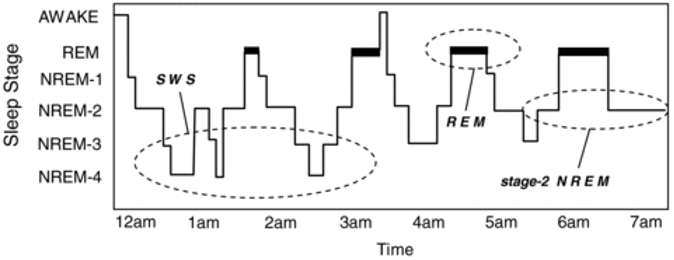
The human sleep cycle. Across the night, NREM and REM sleep cycle every 90 minutes in an ultradian manner, while the ratio of NREM to REM sleep shifts. During the first half of the night, NREM stages 3 and 4 NREM (SWS) dominate, while stage 2 NREM and REM sleep prevail in the latter half of the night. EEG patterns also differ significantly between sleep stages, with electrical oscillations such as slow delta waves developing in SWS, K-complexes and sleep spindles occurring during stage 2 NREM, and theta waves seen during REM.
Source: The Role of Sleep in Cognition and Emotion – Walker – 2009
Neurobiological Mechanisms: How Does Sleep Regulate Emotion Behind the Scenes?
Why is it that poor sleep often leaves us emotionally depleted or unstable the next day? The answer lies in the neurobiological interplay between key emotional centers of the brain during sleep.
Both REM and slow-wave sleep facilitate complex emotional and memory consolidation processes. During these stages, the amygdala (responsible for emotional reactivity), hippocampus (critical for memory), and prefrontal cortex (central to regulation and control) engage in orchestrated activity that underpins our ability to process emotional experiences. REM sleep, in particular, appears to support the attenuation of negative emotional reactivity by modulating amygdala activation and strengthening prefrontal control mechanisms (Walker & van der Helm, 2009).
Similarly, SWS contributes to emotional regulation by promoting cognitive resilience and reducing affective overload. A reduction in slow-wave sleep is consistently associated with increased emotional lability and reduced coping capacity. Thus, both REM and SWS are essential to the nightly recalibration of emotional and cognitive systems.
Clinical Applications: How Can Sleep Architecture Help Diagnose and Treat Emotional Disorders?
Depression
In depressive disorders, polysomnographic studies frequently reveal altered sleep architecture. Specifically, shortened REM latency (the time between sleep onset and first REM stage) and increased total REM sleep. These changes are believed to reflect an over-processing of negative emotional content and impaired affective regulation (Palagini et al., 2013). Early detection of these sleep abnormalities through polysomnography can guide personalized therapeutic strategies, including pharmacological interventions and cognitive-behavioral therapy for insomnia (CBT-I).
Anxiety Disorders
Patients with anxiety disorders often experience disrupted sleep continuity, reduced deep sleep, and heightened nocturnal arousal. These disturbances are thought to mirror the state of chronic hyperarousal associated with anxiety, thereby impairing overnight emotional recalibration. Incorporating sleep-focused approaches into anxiety treatment has shown promise in improving emotional stability and long-term outcomes (Alvaro et al., 2013).
Post-Traumatic Stress Disorder (PTSD)
In individuals with PTSD, polysomnographic profiles often reveal fragmented REM sleep and diminished slow-wave activity. These alterations are consistent with impaired processing of trauma-related memories and sustained emotional distress. Targeted sleep therapies, when integrated with trauma-focused cognitive interventions, have been shown to reduce symptom severity and enhance emotional processing (Germain, 2013).
Predictive Value: Can Changes in Sleep Predict the Onset of Emotional Disorders?
Can sleep patterns offer early warning signs of future psychological distress?
Recent longitudinal studies suggest that sleep architecture may serve as a biomarker for emotional disorders even before clinical symptoms emerge. For example, elevated REM activity or a decline in SWS has been found to precede the onset of mood disorders in some individuals (Baglioni et al., 2011). By identifying these subtle shifts early, clinicians can intervene before full-blown psychiatric conditions develop, making sleep analysis a potentially powerful tool for preventative mental health care.
Therapeutic Implications: How Can We Leverage Sleep to Improve Emotional Well-being?
Cognitive Behavioral Therapy for Insomnia (CBT-I)
CBT-I is one of the most empirically supported treatments for sleep disturbances and has shown significant secondary benefits for emotional disorders. By stabilizing sleep patterns, increasing SWS, and reducing abnormal REM activity, CBT-I enhances emotional resilience and reduces symptoms of depression and anxiety.
Sleep Hygiene Interventions
Basic behavioral changes such as maintaining consistent sleep schedules, limiting screen time before bed, and creating a relaxing bedtime routine can substantially improve sleep quality. These changes, while simple, can lead to measurable improvements in sleep architecture and, consequently, emotional functioning.
Future Directions: Will Wearable Technology Transform Emotional Healthcare?
Emerging wearable and portable polysomnographic technologies are making it increasingly feasible to monitor sleep patterns continuously and in naturalistic settings. These innovations allow for real-time emotional assessment and individualized treatment protocols based on nightly sleep data. As the integration of sleep metrics into clinical mental health practice grows, a future of precision-based emotional healthcare may become a standard reality.
Conclusion: Sleep as a Central Indicator of Psychological Health
Far from being a passive activity, sleep serves as a biologically rich indicator of emotional function. Through the systematic analysis of sleep architecture, mental health professionals gain a unique vantage point on emotional vulnerability, resilience, and disorder risk. As sleep research continues to evolve and measurement tools become more accessible, sleep is poised to become a cornerstone of personalized emotional healthcare.
References
- Walker, M. P. (2009). The role of sleep in cognition and emotion. Annals of the New York Academy of Sciences, 1156(1), 168–197. https://doi.org/10.1111/j.1749-6632.2009.04416.x
- Walker, M. P., & van der Helm, E. (2009). Overnight therapy? The role of sleep in emotional brain processing. Psychological Bulletin, 135(5), 731–748. https://doi.org/10.1037/a0016570
- Palagini, L., Baglioni, C., Ciapparelli, A., Gemignani, A., & Riemann, D. (2013). REM sleep dysregulation in depression: State of the art. Sleep Medicine Reviews, 17(5), 377–390. https://doi.org/10.1016/j.smrv.2012.11.001
- Alvaro, P. K., Roberts, R. M., & Harris, J. K. (2013). A systematic review assessing bidirectionality between sleep disturbances, anxiety, and depression. Sleep, 36(7), 1059–1068. https://doi.org/10.5665/sleep.2810
- Germain, A. (2013). Sleep disturbances as the hallmark of PTSD: Where are we now? American Journal of Psychiatry, 170(4), 372–382. https://doi.org/10.1176/appi.ajp.2012.12040432
- Baglioni, C., et al. (2011). Insomnia as a predictor of depression: A meta-analytic evaluation of longitudinal epidemiological studies. Journal of Affective Disorders, 135(1–3), 10–19. https://doi.org/10.1016/j.jad.2011.01.011