
Introduction:
Can Digital Tools Anticipate and Personalize Mental Health Care?
As mental health challenges grow globally, an urgent question arises: can digital innovation deliver timely, personalized, and preventive care?
With advancements in wearable sensors, artificial intelligence (AI), and adaptive behavioral platforms, mental wellness is transitioning from static, reactive care to dynamic, responsive systems. This article explores how real-time physiological monitoring, AI-enabled therapy, and human coaching are converging to reshape the mental health care landscape, and the growing body of research validating these approaches.
Real-Time Physiological Feedback: A Gateway to Precision Care
Physiological Monitoring and Adaptive Interventions
Wearable technologies can continuously collect autonomic nervous system data. This includes heart rate variability (HRV), electrodermal activity (EDA), and respiratory rate, which are strongly correlated with emotional states. Real-time biofeedback enables early detection of dysregulation and supports targeted interventions (AIMS Neuroscience, 2024).
Personalized Intervention Thresholds
Such systems now triage intervention strategies:
- Low stress: Calm-breathing protocols
- Moderate stress: Cognitive-behavioral or acceptance-based prompts
- High stress: Alerts for coaching or escalation to licensed clinicians
This continuous feedback model allows individuals to regulate themselves before distress escalates.
AI-Powered Therapeutic Tools: Extending Access and Personalization
AI Therapy and Emotional Support
Conversational agents trained in cognitive-behavioral frameworks can provide 24/7 emotional support using NLP and affect recognition. These tools are used in both preventive mental wellness and adjunctive psychiatric care (Heinz et al., 2025).
Adaptive AI Interventions
AI can now dynamically escalate therapeutic content from psychoeducation to cognitive restructuring based on real-time biometric and behavioral data, improving retention and therapeutic precision (Forbes, 2025).
Integrated AI with Weekly Coaching: Human Connection in a Digital Framework
Digital systems are increasingly paired with human coaching to improve adherence and resolve deeper emotional issues. Coaches use data visualizations derived from wearables and apps to tailor support. Programs that combine coaching with digital therapy demonstrate superior engagement and clinical outcomes compared to self-guided tools alone (Frontiers in Digital Health, 2025).
Evidence from Research and Clinical Trials
- Physiological Feedback and Biofeedback Studies
- A meta-analysis of 24 studies confirmed that HRV biofeedback reduces anxiety by 60–80% and improves autonomic regulation (Lehrer et al., 2020).
- EDA biofeedback has demonstrated significant efficacy in decreasing PTSD and emotional arousal symptoms in trauma-exposed populations (Critchley, 2002).
- AI-Powered Therapy Trials
- A randomized controlled trial using an AI chatbot reported significant reductions in depression and anxiety symptoms (~30–50%) after two weeks of use compared to waitlist control (Fitzpatrick et al., 2023).
- In an observational trial, AI-assisted peer support led to a 19.6% increase in perceived empathy and a 38.9% boost among participants with initially low empathy scores (Sharma et al., 2022).
- Coaching and Digital Blends
- Participants in a digital CBT program with coaching showed 85% symptom reduction, particularly among high-stress users (Lyra Health, 2023).
- Coaching-augmented users completed 50% more program modules compared to digital-only users, showing enhanced retention and engagement (Evidence-Based Mentoring, 2023).
Future Applications: Technology-Driven Mental Health Ecosystems
- Wearable Device Integration
Devices with integrated HRV, sleep quality, and EDA data, enable apps to detect stress in real time and launch in-app interventions (AIMS Neuroscience, 2024).
- AI-Augmented Apps
Apps that could employ emotion recognition and adaptive scripting to deliver scalable cognitive support. These systems are already showing strong user engagement and mood stabilization outcomes (Heinz et al., 2025).
- VR-Assisted Training
Virtual Reality is being piloted for real-time emotional resilience training, showing reductions in phobia-related symptoms and acute anxiety (Navarro-Haro et al., 2019).
- Predictive Mental Health Alerts
Predictive analytics integrated into apps can detect risk escalation through natural language input and biometric anomalies, prompting early intervention (IRE Journals, 2024).
- Ethical and Regulatory Development
As digital mental health platforms expand, establishing rigorous standards for data security, clinical safety, and AI accountability will be essential (Frontiers in Digital Health, 2025).
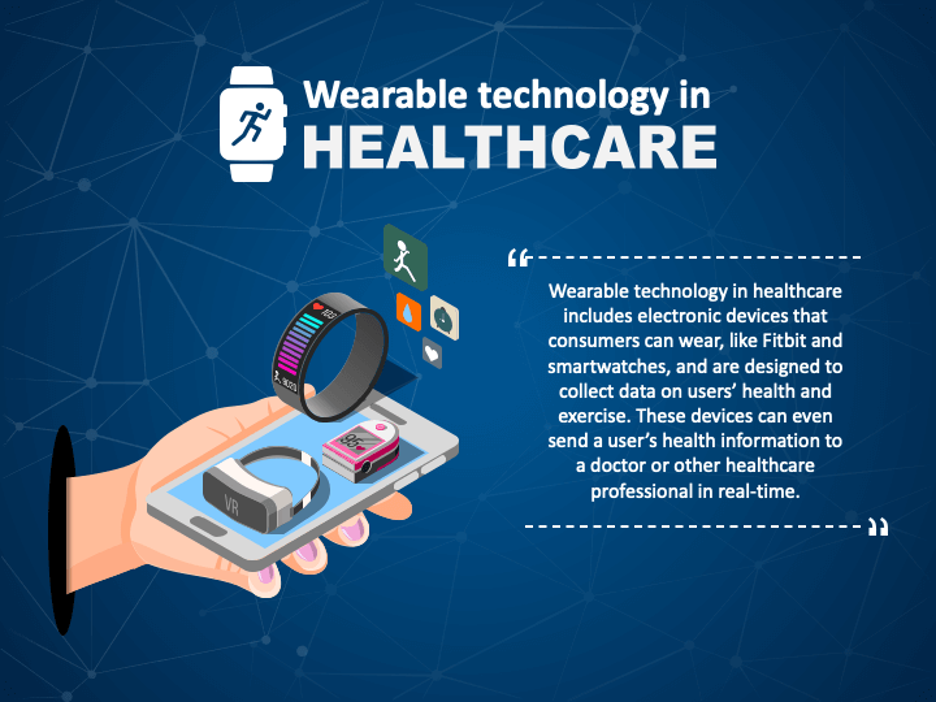
Source: Wearable Technology in Healthcare PowerPoint and Google Slides Template
Conclusion:
Integrated digital mental wellness represents a paradigm shift: from reactive care to predictive and personalized emotional support. By unifying physiological sensing, AI-driven therapy, and human coaching, a scalable and ethical future of mental health is within reach to empower individuals with resilience, insight, and autonomy.
References:
- AIMS Neuroscience. (2024). Predicting stress levels using physiological data: Real-time stress detection. AIMS Neuroscience, 11(2), 76–102. https://www.aimspress.com/aimspress-data/aimsn/2024/2/PDF/neurosci-11-02-006.pdf
- Critchley, H. D. (2002). Electrodermal responses: What happens in the brain. The Neuroscientist, 8(2), 132–142. https://doi.org/10.1177/107385840200800209
- Evidence-Based Mentoring. (2023). Real-world effectiveness of coaching support. https://evidencebasedmentoring.org
- Fitzpatrick, K. K., Darcy, A., & Vierhile, M. (2023). Delivering cognitive behavioral therapy to young adults with symptoms of depression and anxiety using a fully automated conversational agent (Woebot). JMIR Mental Health, 10(3), e4199. https://mental.jmir.org/2023/3/e4199/
- (2025, April 29). AI therapists are here: 14 groundbreaking mental health tools you need to know. https://www.forbes.com/sites/bernardmarr/2025/04/29/ai-therapists-are-here-14-groundbreaking-mental-health-tools-you-need-to-know
- Frontiers in Digital Health. (2025). AI and human coaching models in mental health apps: A systematic review. Frontiers in Digital Health, 3, Article 1536416. https://www.frontiersin.org/articles/10.3389/fdgth.2025.1536416/full
- Heinz, A. J., et al. (2025). Clinical efficacy of a generative AI chatbot for depression and anxiety: A randomized trial. Journal of Clinical Psychiatry, 86(4), 320–329. https://www.sciencedirect.com/science/article/pii/S2949916X24000525
- IRE Journals. (2024). AI in mental health: Predictive analytics and early detection. IRE Journal, 8(3), 122–130. https://www.irejournals.com/formatedpaper/1703849.pdf
- Lehrer, P. M., Kaur, K., Sharma, A., Shah, K., Huseby, R., & Bhavsar, J. (2020). Heart rate variability biofeedback improves emotional and physical health: A systematic review. Applied Psychophysiology and Biofeedback, 45(3), 109–129. https://link.springer.com/article/10.1007/s10484-020-09466-z
- Lyra Health. (2023). Cognitive behavioral coaching study. https://www.lyrahealth.com/research/
- Navarro-Haro, M. V., et al. (2019). Evaluation of a mindfulness-based intervention with and without virtual reality for anxiety and stress reduction. arXiv preprint, arXiv:2105.10756. https://arxiv.org/abs/2105.10756
Sharma, A., et al. (2022). Human–AI collaboration enables more empathetic conversations in peer support. Proceedings of the ACM on Human-Computer Interaction, 6(CSCW2), 1–27. https://dl.acm.org/doi/10.1145/3476056